
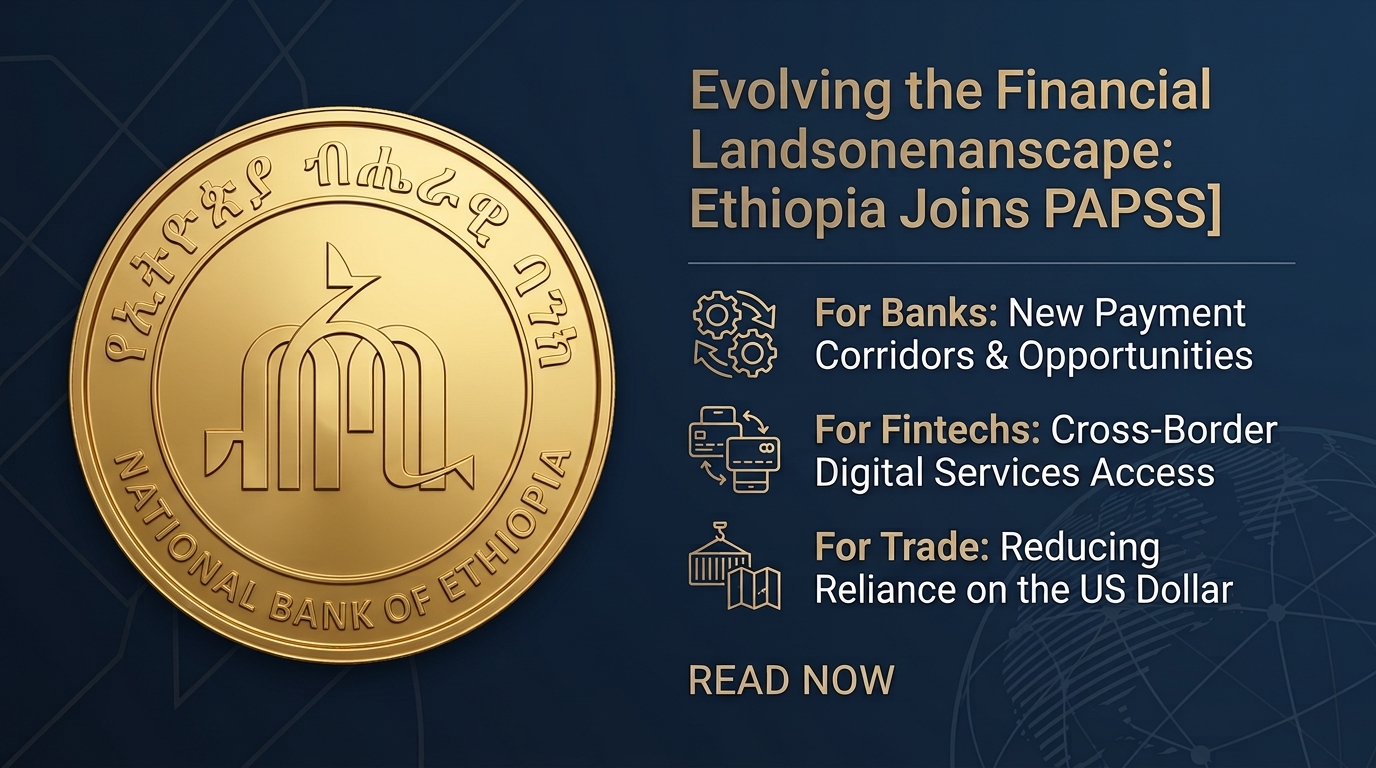
Ethiopia Joins PAPSS: What Does it Mean for Banks, Fintechs and Cross-Border Trade
On 15 October 2026, Ethiopia officially joined the Pan-African Payment and Settlement System (PAPSS), a continental payment infrastructure designed to facilitate cross-border payments in African currencies. The announcement was made by National Bank of Ethiopia (NBE) Governor Eyob Tekalign and PAPSS Chief Executive Officer Mike Ogbalu III at the Ethiopia Finance Forum in Addis Ababa. Ethiopia’s accession marks an important development in the country’s engagement with regional financial infrastructure and its efforts to deepen trade and payment connections across Africa.
PAPSS was developed to address a longstanding difficulty in intra-African commerce: payments between two African countries have often relied on correspondent banking arrangements and an intermediary international currency, commonly the United States dollar. By enabling participating financial institutions to route payments through a shared continental system and settle eligible transactions in local currencies, PAPSS is intended to reduce payment friction, improve efficiency and support trade under the African Continental Free Trade Area (AfCFTA). Ethiopia is also scheduled to co-host PAPSS COWRY 2026 in Addis Ababa on 26–27 November 2026, placing the country within the wider discussion on Africa’s payment integration.
PAPSS is a cross-border payment and settlement system that connects participating payment systems, central banks and financial institutions. It is intended to allow a payer in one participating country to make a payment in that country’s currency while the beneficiary receives funds in the currency used in the beneficiary’s country, subject to the applicable corridor, exchange arrangements and participation rules. The system supports payment messaging, compliance screening and settlement arrangements designed for cross-border transactions.
A key distinction is that PAPSS is payment infrastructure, not a single African currency and not a general guarantee of currency convertibility. It does not, by itself, eliminate foreign-exchange risk, remove national exchange, control rules or ensure that every currency can be exchanged without limits. Nor does Ethiopia’s accession mean that every Ethiopian bank, payment service provider or fintech is already connected and ready to process PAPSS transactions. Actual access will depend on implementation arrangements, technical integration, participation requirements, liquidity arrangements and any applicable regulatory approvals.
Accordingly, the statement that PAPSS can reduce reliance on the US dollar should be understood in a specific sense. For eligible transactions between participating African markets, the system may reduce the need to route each payment through a dollar-based correspondent chain. It does not mean that the dollar will cease to be used in Ethiopia’s international trade or that all cross-border payments will be settled outside the dollar system.
Under a conventional correspondent-banking arrangement, a payment between businesses in two African countries may pass through one or more intermediary institutions. Depending on the corridor and the currencies involved, the transaction may require multiple foreign-exchange conversions, incur correspondent-bank charges and take several business days to complete. The parties may also have limited visibility over intermediary fees and the final amount received.
PAPSS is designed to shorten this process by transmitting payment instructions across its network and enabling the relevant participating institutions to settle through an agreed framework. PAPSS materials describe near-real-time processing, with payments potentially completed within approximately 120 seconds when all participating institutions and systems are available and the transaction meets the applicable requirements. Processing speed should not, however, be confused with the final settlement of every interbank obligation or treated as a guaranteed service level for every transaction.
The system’s settlement model also involves liquidity management. Participating institutions must have access to sufficient funds to meet payment obligations, and settlement arrangements may include prefunding and the netting of obligations. Netting can reduce the amount that must ultimately be settled between participants compared with settling every payment separately. Nevertheless, netting does not remove the need to meet a net payable position, and it does not eliminate liquidity, operational or counterparty risk. The precise arrangements applicable to Ethiopia will depend on the operational framework adopted by the NBE and PAPSS.
For Ethiopian banks, PAPSS may create an additional channel for serving importers, exporters and other customers making payments to participating African markets. If implementation provides accessible and competitive corridors, businesses may benefit from fewer intermediaries, clearer payment tracking and potentially lower transaction costs. This could be relevant to trade in agricultural products, manufactured goods, services and other goods exchanged between Ethiopia and African trading partners.
The scale of these benefits will depend on more than membership. Banks will need to understand the participation model, establish appropriate customer and counterparty procedures, integrate their payment systems and ensure that settlement liquidity is available when required. Technical readiness may include secure messaging, reconciliation processes, transaction monitoring and the ability to handle operational exceptions. PAPSS uses ISO 20022 messaging standards, making interoperability and the quality of payment data important considerations for institutions connecting to the network.
Banks will also need to assess the commercial case for participation. Potential savings should be evaluated against onboarding and integration costs, transaction charges, foreign-exchange pricing, liquidity requirements and customer demand. A new payment rail is most valuable where businesses can use it for real transactions at a competitive total cost, rather than merely because the infrastructure exists.
Ethiopia’s PAPSS accession is relevant not only to banks but also to the country’s growing digital financial services sector. Payment system operators, payment gateways, switches, mobile-money providers and other fintechs may see opportunities to support merchants and customers engaged in cross-border African trade. Depending on the applicable PAPSS participation model, a fintech may be able to connect directly where eligible or provide services through a participating bank or other authorized institution.
For payment gateways and merchant-facing providers, potential use cases include collecting payments from customers in participating African markets, supporting Ethiopian businesses selling goods or services regionally, and improving the payment experience for merchants whose customers are located outside Ethiopia. Switches and payment infrastructure providers may also have a role in routing, interoperability, technical integration or enabling services for regulated participants.
These opportunities should not be interpreted as an automatic right for every fintech to access PAPSS directly. Providers will need to confirm the applicable eligibility requirements, contractual arrangements, licensing conditions and technical standards. Where a provider operates through a sponsoring bank or another participant, the parties will need to allocate responsibility for transaction processing, customer due diligence, sanctions screening, settlement, complaints, reversals, fraud losses and regulatory reporting. The legal structure should be clear before a service is launched.
One of PAPSS’s principal policy objectives is to reduce the friction associated with cross-border payments and limit the need for foreign currency to intermediate every individual transaction. Where payment flows between participating countries offset one another, net settlement may reduce the aggregate amount of foreign exchange required for settlement. This could help reduce some transaction costs and ease pressure on foreign-exchange resources associated with eligible intra-African payments.
The effect should not be overstated. If Ethiopia’s payment obligations to other participating countries exceed the amounts payable to Ethiopia, a net deficit may still need to be settled under the applicable arrangements. PAPSS does not eliminate the underlying economic imbalance between imports and exports, create foreign currency where none is available or remove the need for appropriate exchange-rate and liquidity management. Its impact on Ethiopia’s foreign-exchange position will depend on the volume and direction of actual transactions, participating currencies, settlement terms and the country’s broader trade position.
For businesses, the most immediate potential benefit may be a more efficient payment route, rather than a fundamental change in foreign-exchange policy. Exporters and importers should compare the total cost and timing of PAPSS-enabled payments with existing alternatives, including exchange-rate spreads, bank fees, settlement requirements and documentation. The system’s practical value will increase as more relevant counterparties and financial institutions become connected.
Cross-border payment services remain subject to applicable Ethiopian law and regulatory oversight. PAPSS participation does not displace the NBE’s authority over regulated financial institutions or remove obligations relating to customer identification, anti-money laundering and counter-terrorist financing, sanctions compliance, foreign exchange, consumer protection, cybersecurity and regulatory reporting. Institutions should ensure that their internal controls address both the requirements of the PAPSS framework and the laws and directives applicable in Ethiopia.
Customer due diligence and transaction monitoring will be particularly important where new corridors or payment products create additional cross-border flows. Institutions should establish clear procedures for identifying customers and beneficial owners, screening relevant parties, investigating unusual transactions, retaining records and escalating suspicious activity. They should also confirm how responsibility for screening and reporting is divided between the originating institution, intermediaries and beneficiary institution.
Data governance and operational resilience require similar attention. Cross-border payment messaging can involve the transfer and processing of personal and financial information across systems and jurisdictions. Participating institutions should assess the applicable data-protection requirements, contractual data-sharing arrangements, record-retention obligations and incident-response procedures. They should also address cybersecurity, business continuity, system availability, reconciliation failures, disputed transactions and the handling of erroneous or delayed payments.
For fintechs and other non-bank providers, regulatory analysis should begin with the precise service to be offered. A provider’s existing licence or authorization should not be assumed to cover every form of cross-border payment activity. Before offering PAPSS-related services, providers should establish whether the proposed activity is permitted under their existing authorization, whether additional approval or a contractual relationship with a participating institution is required, and which party bears the relevant compliance and settlement obligations.
The benefits of Ethiopia’s accession will depend on effective implementation. The NBE, PAPSS and participating institutions will need to establish the technical, operational and settlement arrangements required for reliable service. Banks and eligible payment providers should identify priority customer use cases, assess their readiness, and engage with relevant counterparties to understand onboarding requirements, transaction limits, fees, settlement cycles and dispute-handling processes.
Businesses should avoid assuming that every African trading partner is already reachable through PAPSS or that every transaction will qualify for local-currency settlement. They should confirm corridor availability with their financial institutions and compare the full cost of available payment options. Institutions, in turn, should communicate clearly about supported markets, currencies, transaction timelines, exchange rates and any documentation requirements.
As adoption develops, useful indicators of success will include the number of connected institutions, the range of operational corridors, transaction volumes, settlement reliability, total customer costs and the extent to which small and medium-sized businesses can use the system. Transparent information on these indicators would help businesses assess whether PAPSS is delivering practical benefits beyond the formal expansion of the network.
Ethiopia’s accession to PAPSS is a significant step in the development of the country’s cross-border payments infrastructure and its participation in Africa’s wider financial integration agenda. The system offers the potential to make eligible intra-African payments more direct, efficient and less dependent on dollar-based intermediary routes. For Ethiopian banks and fintechs, it may create new service opportunities and support businesses seeking to trade across the continent.
Those benefits are not automatic. They will depend on implementation, institutional connectivity, liquidity management, commercial adoption and compliance with applicable regulatory requirements. PAPSS should therefore be understood as an additional payment and settlement channel—not a replacement for all existing international payment systems or a guarantee that the US dollar will no longer be needed. Its significance for Ethiopia will ultimately be measured by whether businesses and consumers can use it safely, reliably and at a competitive cost.